
TL;DR

Turn your wind-down time into listening time
- Thousands of audiobooks, podcasts and originals
- Listen on your phone, tablet or Echo — also offline
- Cancel anytime
A MedPage Today neurology roundup published Nov. 3, 2026, highlighted a New York Times account of Edward Freytag, whose traumatic brain injury was associated with exceptional musical ability. It also summarized prospective findings that half of long COVID patients had meaningful symptom improvement within three years and a cohort study linking hospital delirium with later dementia and mild cognitive impairment.
A MedPage Today neurology roundup published Nov. 3, 2026, highlighted three developments: a reported case of exceptional musical ability after traumatic brain injury, study data showing meaningful long COVID symptom improvement in half of patients within three years, and a cohort study associating hospital delirium with later dementia and mild cognitive impairment. The items concern separate reports and do not establish that brain injury generally creates musical talent or that delirium causes dementia.
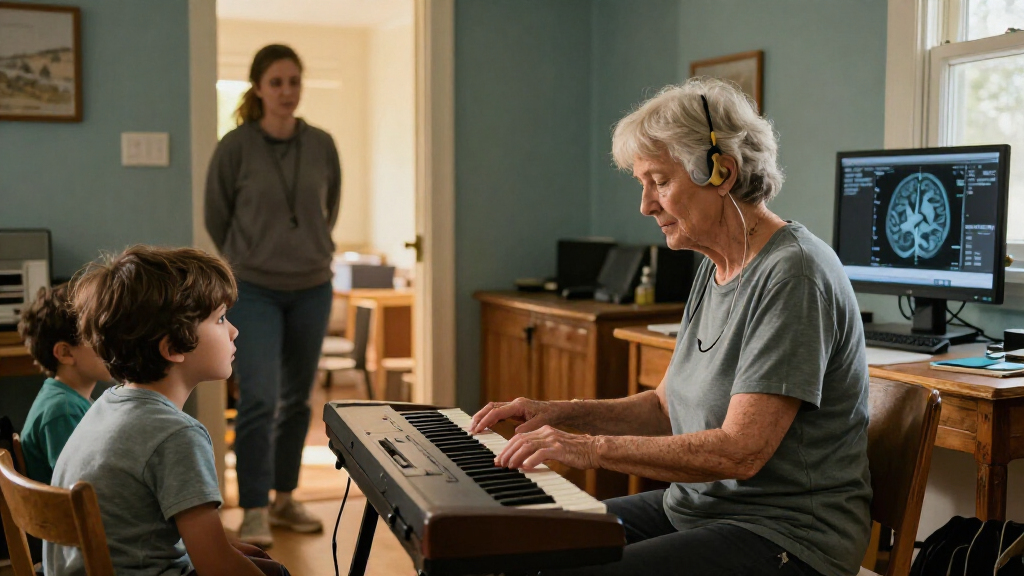
The roundup said The New York Times detailed the story of Edward Freytag, whose traumatic brain injury was described as making him a musical genius. The MedPage Today summary provides no clinical details about Freytag’s injury, the timing of his musical abilities, or how they were assessed. The account is a reported individual story, not evidence that similar injuries typically produce new musical skills.
In findings from the RECOVER-Adult prospective study, half of people with long COVID had meaningful symptom improvement within three years, according to the roundup’s description of research published in the Annals of Internal Medicine. The summary does not specify how improvement was defined, the number of participants, or whether symptoms resolved completely. The finding describes improvement over time, not a guaranteed recovery for an individual patient.
A separate cohort study published in JAMA Neurology found that delirium during hospitalization was strongly linked with dementia and mild cognitive impairment in subsequent years, the roundup reported. It gives no effect size or study population details. An association does not by itself show that delirium caused later cognitive impairment; underlying illness and other factors may also matter.
What the Findings Say About Recovery
Together, the reports touch on questions that matter to patients and families: whether neurological changes can accompany brain injury, how long COVID symptoms may change over time, and what delirium could signal about cognitive health after a hospital stay. The long COVID result offers a measured time frame for improvement, while also making clear that symptom trajectories vary and that improvement is not the same as full recovery.
The delirium association may be relevant to discussions of cognitive follow-up after hospitalization, but the brief summary does not establish a prevention strategy or prove a causal pathway. The Freytag account draws attention to an unusual individual experience; readers should not take it as a prediction about outcomes after traumatic brain injury. Each finding needs to be understood within the design and limits of its underlying report.
Products Worth Considering

Withings Sleep Under-Mattress Sleep Tracking Pad

Hyperice Normatec Elite Wireless Compression Boots, Standard Size

Philips Sonicare 5950 Rechargeable Electric Toothbrush with 2 Brush Heads, Pink
As an affiliate, we earn on qualifying purchases.
Three Separate Neurology Reports
The source is a short news and commentary roundup by Judy George, MedPage Today’s deputy managing editor, rather than one study examining all three topics. It also summarized unrelated developments, including a partial FDA clinical hold on Bright Minds Biosciences’ investigational seizure drug after toxicity was identified in mice, and FDA acceptance of uniQure’s application for its Huntington’s disease gene therapy candidate.
Other research items in the roundup covered infantile-onset epilepsy incidence, brain imaging in pulmonary hypertension and antibiotic-associated neuropathy risk. These reports provide the publication’s broader neurology-news setting, but they are distinct from the three developments addressed here. The listed study journals were Annals of Internal Medicine for the long COVID findings and JAMA Neurology for the delirium association.
“Half of long COVID patients had meaningful symptom improvement within 3 years.”
— MedPage Today roundup, summarizing the RECOVER-Adult study
Limits of the Available Summaries
The roundup does not provide the underlying studies’ sample sizes, participant characteristics, detailed methods or numerical estimates for the long COVID and delirium findings. It is therefore not possible from this source alone to judge how broadly the results apply, how symptom improvement was measured, or how large the association between delirium and later cognitive impairment was.
For Freytag’s story, the summary does not explain the nature of his injury or the evidence used to describe his musical ability. It also does not establish a mechanism linking the injury with that ability. The separate reports should not be combined into a single conclusion about brain injury, recovery or dementia risk.
Full Studies and Follow-Up
Readers seeking the methods and results should consult the full RECOVER-Adult report in the Annals of Internal Medicine and the delirium cohort study in JAMA Neurology. Those publications can clarify the participant groups, outcome definitions and statistical results omitted from the roundup. Further follow-up research will be needed to explain how long COVID symptoms change over time and whether the delirium association can guide cognitive care after hospitalization.
The MedPage Today item does not announce a specific next milestone for the Freytag account or either study. At present, the confirmed development is the publication of the roundup and its summaries of separate reports; additional details and any further reporting remain to be seen.
Key Questions
What did the report say about long COVID?
It summarized RECOVER-Adult prospective data indicating that half of patients had meaningful symptom improvement within three years. The brief account does not define the improvement measure or say that all symptoms resolved.
Does the delirium study show that delirium causes dementia?
No. The roundup describes a strong association between delirium during hospitalization and later dementia or mild cognitive impairment. A cohort association alone does not prove cause and effect.
Did brain injury generally create musical ability?
The roundup recounts an individual story about Edward Freytag. It does not present evidence that traumatic brain injury generally produces exceptional musical ability.
Where were the studies published?
The long COVID findings appeared in the Annals of Internal Medicine, while the delirium cohort study appeared in JAMA Neurology, according to MedPage Today.
Source: medpagetoday.com