
TL;DR

Turn your wind-down time into listening time
- Thousands of audiobooks, podcasts and originals
- Listen on your phone, tablet or Echo — also offline
- Cancel anytime
A small, open-label feasibility trial found that most participants with methamphetamine use disorder completed at least 45 of 50 accelerated TMS sessions. Researchers also reported lower self-reported craving and depression severity after 12 visits, but the study was not designed to establish treatment effectiveness, and cue-induced craving changed little.
A small feasibility trial suggests that an accelerated transcranial magnetic stimulation (TMS) schedule can be delivered to people with methamphetamine use disorder, while early measures showed lower self-reported craving and depression severity. The study was not designed to prove that TMS reduces methamphetamine use, and the findings need testing in a larger controlled trial.
Manish Jha, MBBS, of UT Southwestern Medical Center in Dallas, presented the findings at the American Society of Functional Neuroradiology meeting in Newport Beach, California. The open-label trial included 20 participants with methamphetamine use disorder. Across the group, participants completed a mean of 46.3 sessions out of 50; 94.7% completed at least 45 sessions, Jha reported.
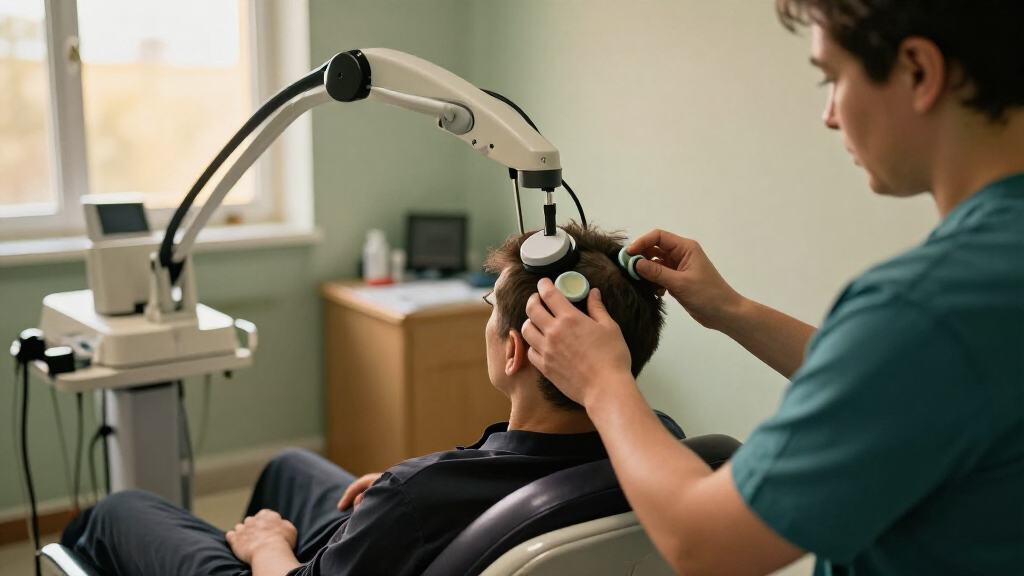
The protocol used 10-minute sessions of intermittent theta burst stimulation (iTBS), with sessions spaced at least 50 minutes apart. Participants were shown images associated with methamphetamine use before each session to prompt craving. After 12 visits, the researchers observed reductions in self-reported craving and overall depression severity. However, there was little change in craving triggered by the images. Participants also reported better ability to resist using methamphetamine after the fourth iTBS session of the day, according to Jha.
The primary goal was to assess feasibility, defined as completing at least 30 of the 50 planned sessions—not to establish whether the treatment prevents drug use or produces lasting benefits. The trial enrolled people with moderate or severe cocaine or methamphetamine use disorder and a Patient Health Questionnaire-9 score of at least 5. Of 23 people enrolled, three had cocaine use disorder and 20 had methamphetamine use disorder; Jha said everyone except one participant completed at least 45 sessions.
A Shorter Schedule Could Ease Access
Conventional repetitive TMS often involves one session a day, five days a week, for six to eight weeks. The accelerated trial compressed treatment into 50 sessions over three weeks. A shorter calendar period could make repeated visits more workable for some patients, though this study did not compare attendance or outcomes directly with a conventional schedule.
That practical question matters because attendance can be difficult in substance-use treatment. Jha cited an earlier feasibility trial of repetitive TMS for stimulant use disorder in which 43.9% of people assigned to treatment attended at least 20 of 30 sessions. The high completion reported in this small methamphetamine-focused trial is encouraging as a feasibility result, but it cannot establish that the accelerated schedule will be broadly acceptable or effective.
Jha said there are no FDA-approved medications specifically for methamphetamine use disorder, and that professional guidelines do not recommend any medication with high confidence for stimulant use disorder. The trial therefore explores a possible treatment approach in an area with a need for additional options. Its early symptom measures are signals for further study, not evidence that TMS is an established treatment.
Transcranial Magnetic Stimulation (TMS) device
As an affiliate, we earn on qualifying purchases.
As an affiliate, we earn on qualifying purchases.
Why Researchers Tested Accelerated TMS
The protocol borrowed elements from the Stanford Accelerated Intelligent Neuromodulation Therapy (SAINT) approach, which was developed for treatment-resistant depression. TMS uses magnetic pulses to stimulate targeted brain regions; iTBS is a patterned form of stimulation. In this study, the researchers paired sessions with methamphetamine-related images to examine responses to cues as well as participants’ reported symptoms.
A 2021 randomized trial of a different approach combined extended-release naltrexone and bupropion for methamphetamine use disorder. The source report said 13.6% of treated participants had negative urine samples after six weeks, compared with 2.5% in the placebo group. That result provides context for ongoing treatment research; it was not part of the TMS trial and does not establish how TMS compares with medication.
Jha also cited rising concern about stimulant-related deaths and methamphetamine use disorder in the United States. The trial itself was small and open-label, with most participants having methamphetamine use disorder and a small number having cocaine use disorder, so its results should be read as an early feasibility report.
“We didn’t see much change in cue-induced craving. What did change a bit was the self-reported craving and how much they were craving currently in the moment before the cue craving. So, there may be some signal.”
— Manish Jha, MBBS, of UT Southwestern Medical Center
accelerated TMS therapy for addiction
As an affiliate, we earn on qualifying purchases.
As an affiliate, we earn on qualifying purchases.
Treatment Benefits Remain Unproven
The trial’s findings do not show whether accelerated TMS reduces methamphetamine consumption, helps participants remain abstinent, or has benefits that last beyond the short observation period. Researchers followed participants for only one week after treatment, and the study did not include a control group. Without a comparison group, changes in self-reported symptoms cannot be attributed confidently to TMS itself.
It is also unclear whether the reported changes in craving and depression would be clinically meaningful, how the approach would perform in a larger and more varied group, or what risks and burdens may emerge with wider use. The report does not provide enough evidence to compare this protocol with other treatments or to recommend it as routine care.
theta burst stimulation TMS machine
As an affiliate, we earn on qualifying purchases.
As an affiliate, we earn on qualifying purchases.
A Controlled Multisite Trial Is Needed
Jha said a multisite randomized controlled trial is needed to replicate and expand the findings. Such a study could compare accelerated TMS with a control condition, measure drug use using objective as well as self-reported outcomes, and follow participants for longer than one week after treatment.
Until those results are available, the present study supports the feasibility of testing an intensive schedule in this population, not a conclusion that the treatment works. No next trial timeline was specified in the report.
Key Questions
What did the methamphetamine TMS trial find?
The small open-label trial found that most participants completed at least 45 of 50 accelerated sessions. Researchers reported lower self-reported craving and depression severity after 12 visits, but little change in cue-induced craving.
Does the study prove that TMS treats methamphetamine use disorder?
No. It was a feasibility study, not a controlled test of treatment effectiveness. It does not establish that TMS reduces methamphetamine use or leads to lasting recovery.
How was the accelerated TMS schedule delivered?
Participants received 10-minute iTBS sessions at least 50 minutes apart, with 50 sessions planned over three weeks. Methamphetamine-related images were presented before sessions.
What happens next?
Jha said a multisite randomized controlled trial is needed to replicate and expand the findings. The report did not give a timeline for that research.
Source: rss
Halloween Picks
halloween
As an affiliate, we earn on qualifying purchases.



![ADHD, Autism Or Complex Trauma? [Pdf]](https://thinkozeal.com/wp-content/uploads/2026/10/adhd-autism-or-complex-trauma-pdf-featured-560x300.jpg)