TL;DR

Turn your wind-down time into listening time
- Thousands of audiobooks, podcasts and originals
- Listen on your phone, tablet or Echo — also offline
- Cancel anytime
A Fit&Well report highlights muscle power—the ability to produce force quickly—as a fitness skill that can be overlooked when discussing exercise in midlife. Trainer Kylie Hansen recommends short, controlled sets of adaptable movements, while the report does not establish that this workout improves longevity or prevents falls.
A Fit&Well report has highlighted muscle power—the ability to produce force quickly—as a fitness skill women may overlook in midlife, alongside better-known strength training. Personal trainer Kylie Hansen recommends a four-move routine with easier modifications, but the report does not present evidence that the workout itself extends lifespan or prevents falls.
Hansen, a NASM-certified personal trainer and coach at Busy Bariatrics, describes power as using strength at speed. She says it can help with quick actions such as catching oneself after a trip or moving rapidly to regain balance. The report says the muscle fibers involved in fast, forceful movements may decline with age and inactivity; it does not quantify that decline or provide a study estimate.
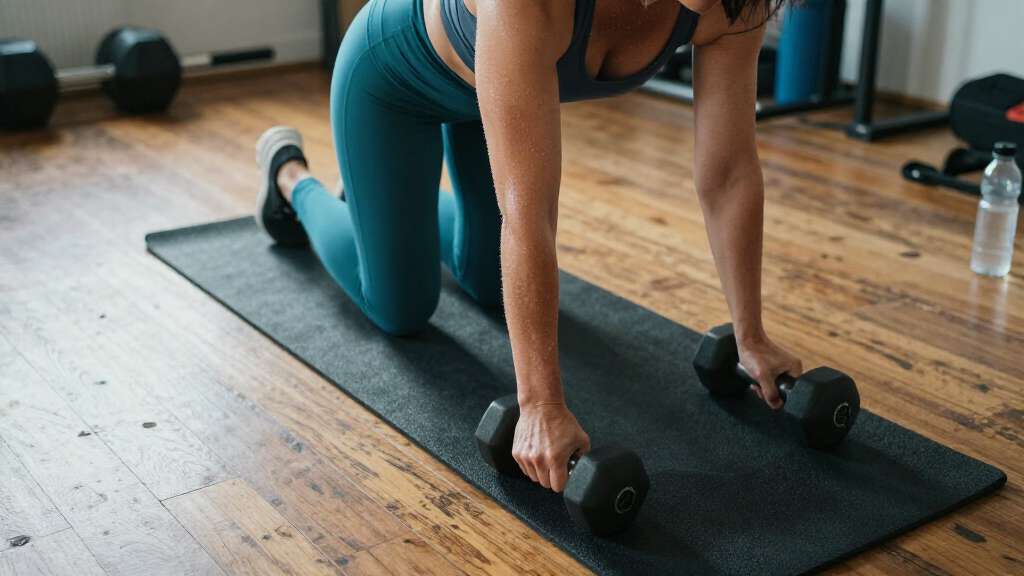
The suggested workout includes burpees, squat jumps, squat-to-upright rows and plank dumbbell pull-throughs. Hansen recommends two or three sets of each movement, generally five or six repetitions, with 60 to 90 seconds of rest between sets. The pull-through is performed for five or six repetitions on each side.
The report emphasizes adapting movements rather than beginning with demanding jumps. A burpee can be stepped through, and a squat jump can be changed to a rise onto the toes. The plank pull-through can be done from the knees. Hansen recommends prioritizing controlled, purposeful repetitions over continuing until exhausted, saying that power drops as fatigue builds.
Power for Everyday Movement
The report draws attention to a distinction that can get lost when exercise advice focuses on strength alone: producing force quickly is not identical to producing force slowly. Hansen’s examples—recovering balance after a stumble or changing direction in a crowded space—connect the skill to ordinary movements, not just athletic performance.
That framing may help readers think about training in terms of both strength and the ability to use it promptly. However, the article offers a trainer’s rationale and a sample workout, not evidence that these four exercises reduce fall rates, preserve independence, or increase longevity. Those outcomes should not be inferred from the exercise suggestions alone.
muscle power training equipment for women
As an affiliate, we earn on qualifying purchases.
As an affiliate, we earn on qualifying purchases.
Strength and Speed Differ
The Fit&Well report notes that strength training is already widely discussed as people age, particularly for women in midlife, while training for muscle power receives less attention. Its central point is not that strength work should be replaced, but that movements performed with speed and intent can train a different physical quality.
The four exercises combine familiar patterns with an emphasis on purposeful movement. Burpees and squat jumps involve forceful whole-body or lower-body actions; the squat-to-row pairs standing with an upper-body pull. The plank dumbbell pull-through is different: Hansen describes it as a way to practise creating stability quickly as the body’s support changes. The supplied report does not cite clinical research or compare this routine with other training plans.
“Power drops as fatigue builds.”
— Kylie Hansen
dumbbell pull-through exercise equipment
As an affiliate, we earn on qualifying purchases.
As an affiliate, we earn on qualifying purchases.
Evidence and Safety Questions
The supplied report does not state when it was published, cite studies supporting its claims about age-related muscle-fiber changes, or give data on how much power typically changes in midlife. It also does not establish that the four-move routine improves longevity or prevents falls. Those remain unanswered by this report.
The article provides general modifications but does not set out individual screening guidance or explain how readers should adapt the workout for specific injuries, health conditions, or limitations. Readers with concerns about whether jumping or loaded movements are suitable for them should seek advice from a qualified health or exercise professional.
low-impact plyometric workout gear
As an affiliate, we earn on qualifying purchases.
As an affiliate, we earn on qualifying purchases.
How Readers Can Use the Routine
The report offers a sample session rather than a longer training plan, progression schedule, or follow-up results. It does not say how often to repeat the workout or describe a method for measuring changes in power. Readers can review the listed modifications and keep the focus on controlled, crisp repetitions, rather than treating the routine as a test of exhaustion.
Whether this particular plan produces lasting changes—and what outcomes those changes might affect—would require evidence beyond the article. The report’s immediate takeaway is narrower: Hansen encourages adding appropriately modified, speed-focused movements to the conversation about fitness in midlife.
adaptable exercise mats for midlife fitness
As an affiliate, we earn on qualifying purchases.
As an affiliate, we earn on qualifying purchases.
Key Questions
What does muscle power mean?
In Hansen’s definition, muscle power is the ability to produce force quickly—using strength at speed.
Which exercises does the report recommend?
The routine lists burpees, squat jumps, squat-to-upright rows and plank dumbbell pull-throughs. Hansen suggests two or three sets, with five or six repetitions for most movements and rest between sets.
Can beginners modify the workout?
Yes. The report suggests stepping through burpees, rising onto the toes instead of jumping, and doing plank pull-throughs from the knees. Hansen recommends moving with control and intent.
Does the report show that the routine extends life or prevents falls?
No. The report explains why Hansen considers power relevant to quick movements, but it does not provide evidence that this specific workout extends longevity or prevents falls.
Source: rss
Halloween Picks
halloween
As an affiliate, we earn on qualifying purchases.