The best adult therapy card game overall in this roundup is the DBT Skills Coaching Cards, which pair a focused skill-building approach with guided examples and goals. For a more flexible set of coping prompts, 108 Mindfulness Cards stand out for range, while Art Therapy Cards offer a creative route into reflection. The main choice is between structured skills practice, open-ended prompts, and conversation-based activities; a larger deck is not automatically a better fit. These cards can support reflection or group discussion, but they are not a substitute for professional care. Read on for the full breakdown and help matching a deck to your needs.

Turn your wind-down time into listening time
- Thousands of audiobooks, podcasts and originals
- Listen on your phone, tablet or Echo — also offline
- Cancel anytime
Key Takeaways
- Structure separates the leading options: DBT Skills Coaching Cards include guided examples and goals, making them a clearer fit for people who want a defined practice rather than prompts alone.
- More cards mean more variety, not necessarily more guidance: the 200-card Resilience Conversation Starter deck and 108-card Mindfulness deck offer breadth, while compact sets may feel easier to use consistently.
- Creative reflection has two distinct formats: Art Therapy Cards center on 42 guided drawing and reflection prompts; the 75-activity Guided Art Therapy deck offers a broader activity pool.
- Specialized needs call for specialized decks: the Recovery Pack focuses on recovery, while Coping Skills Cards and Mind Brain Emotion focus on coping and emotional insight.
- Group use changes the choice: You Know Social Skills and the Resilience Conversation Starter deck are more conversation-oriented than solo skill-practice cards.
| Coping Skills Cards for Anxiety and Stress Relief |  | Best for On-the-Go Coping Prompts | Brand: Deyl cavier | Set contents: 10 cards | Coping skills: 20+ | VIEW LATEST PRICE | See Our Full Breakdown |
| DBT Skills Coaching Cards with Guided Examples and Goals, 25 Cards |  | Best for Structured DBT Practice | Brand: UHillMinerva | Card count: 25 total: 1 instruction card and 24 concept cards | Card size: 2.5 × 3.5 inches | VIEW LATEST PRICE | See Our Full Breakdown |
| You Know Social Skills and Therapy Card Game |  | Best for Group Social-Skills Conversation | Brand: Therapy U | Players: 2–6 | Recommended age: 6 years and up | VIEW LATEST PRICE | See Our Full Breakdown |
| Art Therapy Cards: 42 Guided Drawing and Reflection Prompts |  | Best for Creative Solo Reflection | Brand: GiftNest | Card count: 42 | Card size: 4 × 6 inches | VIEW LATEST PRICE | See Our Full Breakdown |
| Resilience Conversation Starter Cards for Families, Therapy, and Counselors (200 Cards) |  | Best for Family Life-Change Conversations | Brand: Talking Point Cards | Model: Resilience | Card count: 200 | VIEW LATEST PRICE | See Our Full Breakdown |
| Guided Art Therapy Card Deck: 75 Activities to Explore Your Feelings and Manage Your Emotional Well-Being |  | Best for Creative Reflection | Number of cards: 75 | Format: Card deck | Activity type: Guided art therapy activities | VIEW LATEST PRICE | See Our Full Breakdown |
| ASKMEANYTHING Recovery Pack Card Game, 100 Cards |  | Best for Recovery Groups | Number of cards: 100 | Players: 3–7 | Age range: 17 years and up | VIEW LATEST PRICE | See Our Full Breakdown |
| Mind Brain Emotion 52 Essential Coping Skills Cards |  | Best for Practical Coping Skills | Brand: Mind Brain Emotion | Number of cards: 52 | Age range: 8 years and up | VIEW LATEST PRICE | See Our Full Breakdown |
| 108 Mindfulness Cards for Coping Skills and Emotional Insight |  | Best for Broad, Structured Practice | Total card count: 108 | Deck structure: 2 decks of 54 cards | Card categories: 10 structured categories | VIEW LATEST PRICE | See Our Full Breakdown |
| adult therapy card game | Brand | Material | Included components | Age range |
|---|---|---|---|---|
| Coping Skills Cards for Anxiet | Deyl cavier | Waterproof PVC | Cards | — |
| DBT Skills Coaching Cards with | UHillMinerva | — | — | 13 years and up |
| You Know Social Skills and The | Therapy U | Cardstock | — | — |
| Art Therapy Cards: 42 Guided D | GiftNest | — | — | — |
| Resilience Conversation Starte | Talking Point Cards | Paper | Cards | Kids, teens, and adults |
| Guided Art Therapy Card Deck: | — | — | — | — |
| ASKMEANYTHING Recovery Pack Ca | — | Paper | Card game deck and instruction manual | 17 years and up |
| Mind Brain Emotion 52 Essentia | Mind Brain Emotion | — | Cards, online coping assessment, and sturdy tin case | 8 years and up |
| 108 Mindfulness Cards for Copi | Blavvennt | Paper | 54 Coping Skills Cards and 54 Emotional Insight Cards | 13 years and up |
More Details on Our Top Picks
Coping Skills Cards for Anxiety and Stress Relief
Portability is the main advantage here: 10 waterproof PVC cards fit on a keyring, so coping ideas can stay close at hand during a commute, at school, or away from home. The deck offers 20+ sensory, movement, and mindfulness techniques, giving it more variety than its small card count suggests. Compared with the DBT Skills Coaching Cards, this set is easier to carry but provides less guidance: its product information does not describe step-by-step instructions, goals, or examples for each technique. That makes it better for someone who already knows how to use simple coping prompts than for a beginner looking for coaching. The compact format also limits how much detail each card can hold. It is a practical prompt aid, not a substitute for therapy, and no clinical effectiveness evidence is provided.
Pros:- Includes more than 20 coping techniques across sensory, movement, and mindfulness activities
- Waterproof PVC construction suits frequent carrying
- Compact cards attach to a keyring for quick access
Cons:- Product information does not provide evidence of clinical effectiveness
- No detailed steps, goals, or real-life examples are specified
- Only 10 cards may leave less room for explanation than larger guided decks
Best for: Adults or older teens who want a small, water-resistant set of coping prompts to carry for quick reference during daily stress.
Not ideal for: People new to coping strategies who need detailed instructions, or anyone seeking a clinically validated therapy resource.
- Brand:Deyl cavier
- Set contents:10 cards
- Coping skills:20+
- Material:Waterproof PVC
- Dimensions:65 × 100 mm
- Included components:Cards
Our verdict“Choose this compact set if you want portable coping reminders, but pick the DBT Skills Coaching Cards for more structured guidance.”
DBT Skills Coaching Cards with Guided Examples and Goals, 25 Cards
Clear coaching structure sets this deck apart: its cards cover Mindfulness, Distress Tolerance, Emotion Regulation, and Interpersonal Effectiveness, with guidance on when to use a skill, its goal, steps, and a real-life example. That extra context makes the cards more approachable for someone who wants to practice a technique rather than simply pick a prompt. Compared with Coping Skills Cards for Anxiety and Stress Relief, this set is less focused on a tiny, waterproof carry format and more focused on explaining skills. The 2.5 × 3.5-inch cards still come with a keychain cable ring and pouch, though the deck has 25 cards total, including one instruction card and 24 concept cards. It is a learning aid, not a replacement for DBT care, and its defined framework may feel narrower than open-ended conversation decks.
Pros:- Covers all four named DBT modules
- Cards include steps, goals, use guidance, and real-life examples
- Keychain cable ring and soft pouch support portable storage
- Age range includes users 13 years and up
Cons:- Only 24 concept cards are included alongside the instruction card
- The DBT framework may not suit readers seeking broader creative or conversational prompts
- Does not replace individualized instruction from a qualified clinician
Best for: Adults and teens who want guided introductions to DBT skills, including practical examples and prompts for when to use each one.
Not ideal for: Buyers who want a large, open-ended conversation game or a self-contained replacement for therapy or professional DBT coaching.
- Brand:UHillMinerva
- Card count:25 total: 1 instruction card and 24 concept cards
- Card size:2.5 × 3.5 inches
- DBT modules:Mindfulness, Distress Tolerance, Emotion Regulation, Interpersonal Effectiveness
- Age range:13 years and up
- Educational objectives:Coping skills, emotional regulation, stress relief
- Included accessories:Keychain cable ring and soft pouch
Our verdict“Pick this deck for guided DBT skill practice; choose the Resilience Conversation Starter Cards for broader group discussion.”
You Know Social Skills and Therapy Card Game
Group interaction is the point of this 108-card game: thought-provoking questions are intended to encourage positive communication, self-esteem, and social skills. Its format suits family game nights, classrooms, counseling sessions, and other groups, while the two-to-six-player range keeps it workable for a small gathering. Unlike the Art Therapy Cards, which center on individual drawing and reflection, You Know asks people to respond and listen to one another. That makes it a more social choice, but also means it cannot be used solo and depends on participants feeling comfortable speaking. The recommended age starts at six, so adults may find the prompts less focused on adult-specific concerns than a dedicated adult therapy resource. I’d choose it for guided group conversation, not for structured clinical skills practice.
Pros:- 108 cards provide a substantial set of conversation prompts
- Designed to encourage positive communication and social skills
- Can be used in family, classroom, counseling, and group settings
- Small-group format accommodates two to six players
Cons:- Requires at least two players
- Broad age range may make some prompts feel less adult-specific
- Conversation prompts do not provide structured steps for practicing therapy skills
Best for: Counselors, teachers, or families looking for a question-based activity to support communication and social-skills practice in a group.
Not ideal for: Adults seeking private reflection, solo exercises, or prompts focused specifically on adult life experiences.
- Brand:Therapy U
- Players:2–6
- Recommended age:6 years and up
- Card count:108
- Material:Cardstock
- Dimensions:3.54 × 2.68 × 1.42 inches
- Weight:7 ounces
- Color:Multicolor
Our verdict“Choose You Know for social-skills conversation with a group, rather than the solo reflection offered by Art Therapy Cards.”
Art Therapy Cards: 42 Guided Drawing and Reflection Prompts
Drawing paired with journaling gives this deck a more introspective format than conversation-first options. Its 42 guided activities combine art prompts with reflection questions, giving users two ways to explore emotions and self-awareness. Compared with You Know Social Skills and Therapy Card Game, it works for individual use and does not require a group to get started; compared with the Resilience Conversation Starter Cards, it asks for active creative work rather than spoken responses. Color-coded themes can help users choose a prompt by emotional focus, and the matte-laminated 4 × 6-inch cards offer room for directions. The tradeoff is that drawing and journaling both take time and may not appeal to someone who wants quick coping cues. It is recommended for ages 14 and up, so it is not a young-child deck.
Pros:- Pairs guided drawing activities with journaling questions
- Suitable for individual use, therapy sessions, and classroom activities
- Color-coded emotion themes help organize prompt selection
- Matte-laminated cards come in a sturdy box
Cons:- Activities require time and willingness to draw and journal
- Not recommended for children under 14
- Less suited to group conversation than the You Know game or Resilience cards
Best for: Teens 14 and older and adults who prefer private, creative exercises for exploring feelings through drawing and writing.
Not ideal for: People who want quick, low-effort coping reminders, dislike drawing or journaling, or need cards for children under 14.
- Brand:GiftNest
- Card count:42
- Card size:4 × 6 inches
- Card finish:Matte laminated
- Recommended age:14 years and above
- Unit count:1
- Packaging:Sturdy box
Our verdict“Pick this deck for creative, private reflection; choose You Know or Resilience for discussion-based group use.”
Resilience Conversation Starter Cards for Families, Therapy, and Counselors (200 Cards)
Broad coverage of difficult life changes is the reason to choose this 200-card set. Its child-friendly prompts are designed to help kids, teens, and adults talk about feelings and experiences such as grief, divorce, moving, or starting college. That makes it more suited to shared discussion across ages than the adult-focused DBT Skills Coaching Cards, which teach named skills, or the creative solo work in Art Therapy Cards. Color-coded prompts can help a facilitator select a topic, and the cards are intended for home, classroom, and counseling use. The tradeoff is that they prompt discussion rather than teach a structured coping method. Some subjects may feel tender, so a caregiver or counselor should use judgment about timing and readiness. This is a conversation aid, not a promise of clinical treatment.
Pros:- Large 200-card set offers many discussion prompts
- Designed for kids, teens, and adults
- Addresses major changes including grief, divorce, moving, and starting college
- Can be used at home, in classrooms, or in counseling
Cons:- Prompts discussion rather than providing structured therapy skills
- Some topics may be sensitive for people experiencing difficult life events
- Paper cards may be less suited to frequent exposure to moisture than PVC options
Best for: Families, counselors, and educators who want a large set of age-inclusive prompts for discussing grief, change, and emotional resilience.
Not ideal for: Buyers seeking step-by-step coping instruction, private solo activities, or prompts that avoid sensitive family experiences.
- Brand:Talking Point Cards
- Model:Resilience
- Card count:200
- Age range:Kids, teens, and adults
- Recommended age:5 years and up
- Material:Paper
- Included components:Cards
- Number of packs:1
Our verdict“Choose Resilience for guided family or counseling conversations about change, but select the DBT deck for explicit skill instruction.”
Guided Art Therapy Card Deck: 75 Activities to Explore Your Feelings and Manage Your Emotional Well-Being
For adults who find it easier to express feelings through making than through conversation, this deck offers 75 guided art activities with step-by-step prompts. That structure can help beginners get started while still giving experienced users room to explore emotions at their own pace. Compared with Art Therapy Cards: 42 Guided Drawing and Reflection Prompts, this deck supplies more activities, making it a stronger choice for repeat use; it also focuses specifically on emotional well-being. The tradeoff is that its creative format may be less useful for someone seeking direct, skill-based coping instructions like those in Mind Brain Emotion 52 Essential Coping Skills Cards. It is a prompt deck, not a substitute for professional care, and the listed contents do not include a digital companion.
Pros:- 75 activities offer a broad range of prompts for repeated use
- Step-by-step directions lower the barrier for people new to art-based reflection
- Creative expression gives users an alternative to conversation-led exercises
- Suitable for individual or group activities at home or in professional settings
Cons:- Creative prompts may not provide the direct coping-skill instruction found in Mind Brain Emotion 52 Essential Coping Skills Cards
- No digital companion or online resources are listed
- Self-guided activities do not replace professional support for serious mental health concerns
Best for: Adults who prefer drawing and other creative exercises to explore emotions alone, with a group, or alongside a therapist
Not ideal for: Buyers looking for explicit CBT, mindfulness, or somatic coping steps, or anyone who needs professional treatment rather than a self-guided activity deck
- Number of cards:75
- Format:Card deck
- Activity type:Guided art therapy activities
- Prompt structure:Step-by-step prompts
- Intended use:Explore feelings and support emotional well-being
- Use settings:Individual, group, home, or professional setting
Our verdict“Choose this deck if guided creative expression is your preferred route to emotional reflection and you want more prompts than the 42-card Art Therapy Cards set.”
ASKMEANYTHING Recovery Pack Card Game, 100 Cards
The 100-card Recovery Pack is the clearest group-discussion choice in this batch: it is designed for coping, self-improvement, and recovery conversations, with a stated player range of three to seven. That makes it a better fit for facilitated group sessions or adult icebreakers than the solo-friendly Guided Art Therapy Card Deck. Its role is conversation and reflection, not structured practice: buyers seeking specific CBT, mindfulness, or somatic exercises may get more actionable guidance from Mind Brain Emotion 52 Essential Coping Skills Cards. The group requirement is a real limitation for someone wanting a private, self-paced tool, and the 17-and-up age guidance narrows who can use it. An instruction manual is included, but the supplied details do not specify individual card prompts or session length.
Pros:- 100 cards provide a sizeable prompt pool for group discussions
- Designed around recovery, coping skills, and self-improvement
- Works as a group therapy discussion aid or an icebreaker
- Includes an instruction manual
Cons:- Requires three to seven players, so it does not suit solo use
- Age guidance starts at 17, limiting use with younger teens
- The supplied description does not identify specific evidence-based exercises or explain individual card formats
Best for: Counselors, peer-support facilitators, and adult recovery groups with three to seven participants who want a conversation-based activity
Not ideal for: Adults seeking a solo coping tool, groups larger than seven, or buyers who need clearly specified skills exercises rather than discussion prompts
- Number of cards:100
- Players:3–7
- Age range:17 years and up
- Included components:Card game deck and instruction manual
- Material:Paper
- Language:English
- Dimensions:5 × 3 inches
- Weight:0.17 kg
- Color:Purple, blue, and white
Our verdict“Pick this for a small adult recovery group that wants guided conversation, not for solo practice or a deck of step-by-step coping exercises.”
Mind Brain Emotion 52 Essential Coping Skills Cards
This deck earns its place for readers who want a card to point toward an action, not just start a conversation. Its 52 coping-skill cards draw on CBT, mindfulness, and somatic exercises for stress, anxiety, and difficult emotions, giving it a more practice-oriented focus than the recovery discussion prompts in ASKMEANYTHING Recovery Pack. The sturdy tin supports carrying the deck, while an online assessment and learning library add resources beyond the cards. Those extras depend on access to a phone, tablet, or computer, so this is not a fully offline package. At 52 cards, it offers fewer prompts than 108 Mindfulness Cards for Coping Skills and Emotional Insight, but its listed age range starts at eight, making it usable across a wider age span than an adults-only deck.
Pros:- Combines CBT, mindfulness, and somatic exercises in one skills-focused deck
- Portable format includes a sturdy tin case
- Online coping assessment and learning library extend the card content
- Age range of eight years and up allows use with younger family members
Cons:- Online learning resources require a phone, tablet, or computer
- The 52-card set offers fewer cards than the 108-card Blavvennt set
- Its exercise-led format may be less engaging for groups seeking a conversation game
Best for: Adults, teens, or families seeking portable, practical CBT, mindfulness, and somatic exercises for everyday stress and emotional challenges
Not ideal for: People who want a wholly offline resource, or adults seeking an explicitly adult-only conversation game rather than coping-skill practice
- Brand:Mind Brain Emotion
- Number of cards:52
- Age range:8 years and up
- Included components:Cards, online coping assessment, and sturdy tin case
- Methods:CBT, mindfulness, and somatic exercises
- Model number:52Coping
- ASIN:B08L6WTBDR
Our verdict“Choose this deck if you want portable, multi-approach coping exercises and do not mind using online resources for the added assessment and learning library.”
108 Mindfulness Cards for Coping Skills and Emotional Insight
With 108 cards split into two color-coded decks, this set pairs coping strategies with emotional insight exercises rather than treating them as separate needs. Each card has an action, an insight, and a practice, creating a repeatable format for solo work, therapy sessions, or guided use with a parent or educator. Compared with Mind Brain Emotion 52 Essential Coping Skills Cards, it offers more cards and a dedicated emotional-insight component; the latter, however, lists online assessment and learning resources that this set does not. The stated CBT, DBT, mindfulness, and somatic influences give it a broad skills focus, but the product details do not include card examples or dimensions. Its age guidance begins at 13, so it is not intended for younger children.
Pros:- 108 cards cover both coping strategies and emotional insight
- Each card combines an action, an insight, and a practice
- Draws on CBT, DBT, mindfulness, and somatic therapy approaches
- Two color-coded boxes separate the 54-card coping and emotional-insight decks
Cons:- No individual card examples are provided in the product details
- Card dimensions are not specified
- Age range starts at 13, excluding younger children
Best for: Adults and therapists who want a sizeable, structured set for pairing everyday coping practice with emotional reflection
Not ideal for: Buyers who need to preview exact exercises or confirm card dimensions before buying, and families seeking a deck for children under 13
- Total card count:108
- Deck structure:2 decks of 54 cards
- Card categories:10 structured categories
- Card format:One action, one insight, and one practice
- Material:Paper
- Age range:13 years and up
- Brand:Blavvennt
- Model:CP01
- Included components:54 Coping Skills Cards and 54 Emotional Insight Cards
Our verdict“Choose this two-deck set if you want a large, structured mix of coping practice and emotional reflection for use at home or in guided sessions.”
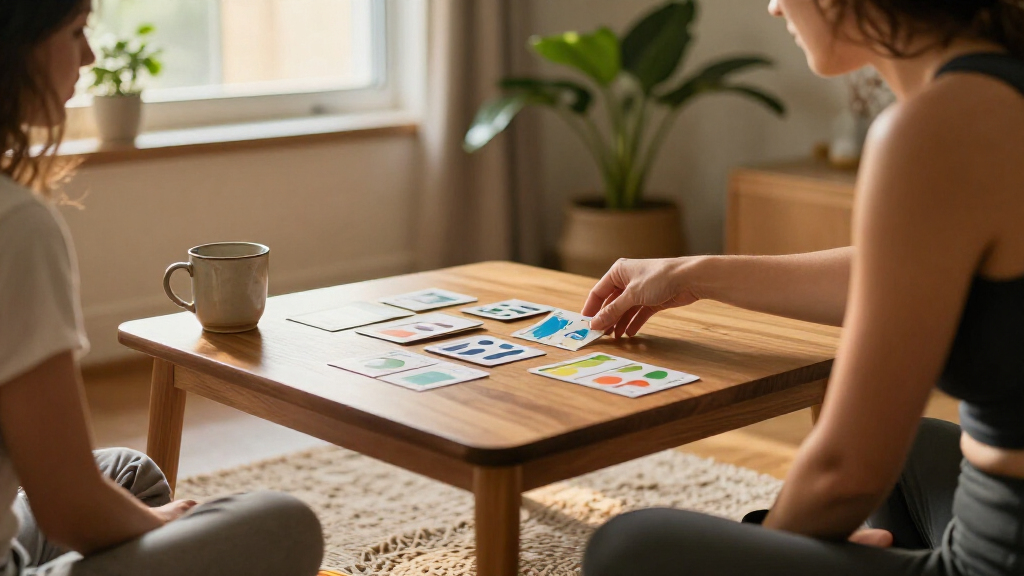
How We Picked
I compared these adult therapy card games by how clearly each deck supports its stated use: practicing coping skills, exploring emotions, building social skills, making art, or opening conversation. I also weighed the amount of guidance, the usefulness of examples or activities, the likely ease of choosing a card and getting started, and how well the format suits individual or group use. Deck size mattered as a measure of variety, not as a stand-alone measure of quality.
The ranking favors options with a clear purpose and a usable path from drawing a card to doing something with it. That puts DBT Skills Coaching Cards first for their guided examples and goals, while more specialized or open-ended decks rank higher for the buyers they serve than as universal picks. I also weighed tradeoffs: broad decks can offer more prompts but less direction, and creative or conversation-focused cards may not meet a buyer looking for step-by-step skills practice. These are self-guided tools, not clinical assessments or replacements for therapy.
| adult therapy card game | Material |
|---|---|
| Coping Skills Cards for Anxiet | Waterproof PVC |
| DBT Skills Coaching Cards with | — |
| You Know Social Skills and The | Cardstock |
| Art Therapy Cards: 42 Guided D | — |
| Resilience Conversation Starte | Paper |
| Guided Art Therapy Card Deck: | — |
| ASKMEANYTHING Recovery Pack Ca | Paper |
| Mind Brain Emotion 52 Essentia | — |
| 108 Mindfulness Cards for Copi | Paper |
Factors to Consider When Choosing Adult Therapy Card Games
Before choosing a deck, decide what you want the cards to do in an actual moment of use. The best fit depends on purpose, guidance, and setting—not just the title or card count. These factors can help you avoid buying a deck that sounds right but does not match how you prefer to reflect or practice.
Choose a clear purpose before choosing a theme
Start with the task you want help with: practicing a specific coping skill, reflecting on emotions, starting a conversation, or doing a creative activity. A deck labeled for therapy can still be built for a very different use than the one you have in mind. Common mistake: choosing the broadest-sounding title when you actually want targeted support, such as recovery-focused prompts or social skills practice. If your needs shift from day to day, a general coping or mindfulness deck may be more adaptable, but it may offer less depth in any one area. For recurring work on a specific topic, a focused deck can make it easier to return to the same kind of practice.
Match the level of guidance to how you like to work
Some people want a clear instruction, example, or goal on each card; others prefer a prompt they can interpret in their own way. More guidance can reduce the effort needed to begin, especially when you are new to a skill or using cards in a facilitated session. Open-ended prompts leave room for personal meaning, but can feel vague if you want a direct action to try. Avoid assuming that the word “therapy” means every card follows a clinical method or provides step-by-step coaching. If you are unsure, choose a format that gives enough direction to start without making every exercise feel prescriptive.
Think about solo, pair, or group use
A card that works well for private journaling may not make a lively group activity, and a conversation starter may feel intrusive when used alone. Before buying, decide who will be present and whether anyone will lead the activity or explain the prompts. Group decks work best when participants can pass on a question without pressure and when the topic suits the relationship between them. A large deck can help a facilitator vary sessions, but size alone does not guarantee that its prompts fit every age, setting, or comfort level. When buying for a group, prioritize clear instructions and flexible participation over novelty.
Treat card count as variety, not a measure of value
A larger deck can reduce repetition over time and supply more options for groups, but it may also take longer to sort through when you want a quick prompt. A smaller deck can feel more approachable and easier to revisit, particularly if it has a focused purpose. Check whether the cards offer genuinely different activities or repeat the same idea in slightly different wording. Do not pay extra attention to the number of cards without weighing how often you expect to use them. For daily practice, a manageable set you will actually return to may serve you better than a broad collection you rarely open.
Decide whether creative activities suit your routine
Art-based decks offer a nonverbal way to explore feelings, which can suit people who find direct questions tiring. They may also call for time, materials, or a willingness to draw, even if the activity is not about making polished art. A prompt-only deck is easier to use on the go, while a guided activity deck may support a longer reflective session. A common mismatch is choosing art therapy cards for quick, structured coping practice when the activities are meant to invite exploration. Think about the space and time you can set aside before choosing a format.
Know the limits of self-guided cards
These decks can prompt reflection, conversation, or skills practice, but they do not diagnose conditions or tailor care to an individual situation. For complex or distressing concerns, a licensed professional can help decide whether a particular activity is suitable. If you are choosing cards for someone else, avoid presenting them as a cure or making participation compulsory. Consider whether the prompts might raise difficult topics and whether you have support available if a session becomes uncomfortable. A deck is most useful when its role and limits are clear from the start.
Frequently Asked Questions
Can adult therapy card games replace therapy?
No. These decks can provide prompts for reflection, coping practice, or conversation, but they cannot assess a person’s needs or offer individualized clinical care. A card may suggest an activity that does not suit a particular situation, so use judgment rather than treating every prompt as advice. If distress is persistent, severe, or affecting daily life, a licensed mental health professional is a better source of support. Cards can complement a care plan when a professional agrees they are appropriate.
Which type of deck is best if I want practical coping exercises rather than discussion prompts?
Look for a deck that names concrete skills and gives clear instructions, examples, or goals. Conversation starters can be useful for sharing and connection, but they may not tell you what action to practice after drawing a card. A coping-focused or DBT-oriented format is more likely to support repeated skills practice. Before choosing, check whether the cards explain how to use the skill and whether the exercises fit the situations you want to address. If you need individualized direction, ask a clinician rather than relying on a general-purpose deck.
Are conversation card decks suitable for use with a therapist or support group?
They can be useful as discussion starters, but suitability depends on the group’s goals and comfort level. A facilitator should review prompts in advance, set expectations about privacy, and make passing on a question an acceptable choice. Some decks are aimed at particular topics or relationships, so a prompt that feels comfortable among close friends may not suit a new group. For therapy sessions, let the clinician decide whether the deck supports the work already underway. Cards should open a conversation, not pressure someone to share more than they want.
Should I choose a larger deck for more variety?
Choose a larger set if you expect to use cards often, facilitate groups, or want many prompts across a broad range of situations. A larger count does not by itself mean more useful content; some decks may offer less guidance than a smaller, more focused set. Think about how quickly you want to select a card and whether you will realistically work through a broad collection. If you prefer a simple routine, a compact deck with a clear purpose may be easier to keep using. Compare the type of activities and instructions, not only the total number of cards.
How do I choose between art therapy cards and coping skills cards?
Choose art-based cards if drawing or making something feels like a comfortable way to explore emotions, and you can set aside time for the activities. Choose coping skills cards if you want prompts centered on actions or techniques you can practice in daily situations. The formats can overlap, but their main jobs differ: creative prompts tend to make room for exploration, while skills decks usually point toward a specific practice. Consider whether you want a reflective activity or a usable strategy in the moment. If neither format feels right, a mindfulness or conversation deck may better match your preference.
Conclusion
For a single starting recommendation, I’d choose DBT Skills Coaching Cards as the best overall pick because guided examples and goals give the deck a clearer route into practice. For best value in breadth, the 200-card Resilience Conversation Starter deck offers the largest stated selection here, especially for family or group discussion; choose it for variety, not step-by-step coaching. The best premium-style choice for a longer creative session is the Guided Art Therapy Card Deck, with 75 activities, while Coping Skills Cards for Anxiety and Stress Relief are the more approachable pick for someone seeking a direct coping-focused starting point. For specific needs, choose ASKMEANYTHING Recovery Pack for recovery-related discussion, You Know Social Skills and Therapy Card Game for social skills, or 108 Mindfulness Cards for a broad mindfulness and emotional-insight focus. Match the deck to the kind of activity you will actually use, and treat any card set as a support tool rather than a substitute for professional care.
Fall Picks
fall essentials
As an affiliate, we earn on qualifying purchases.